
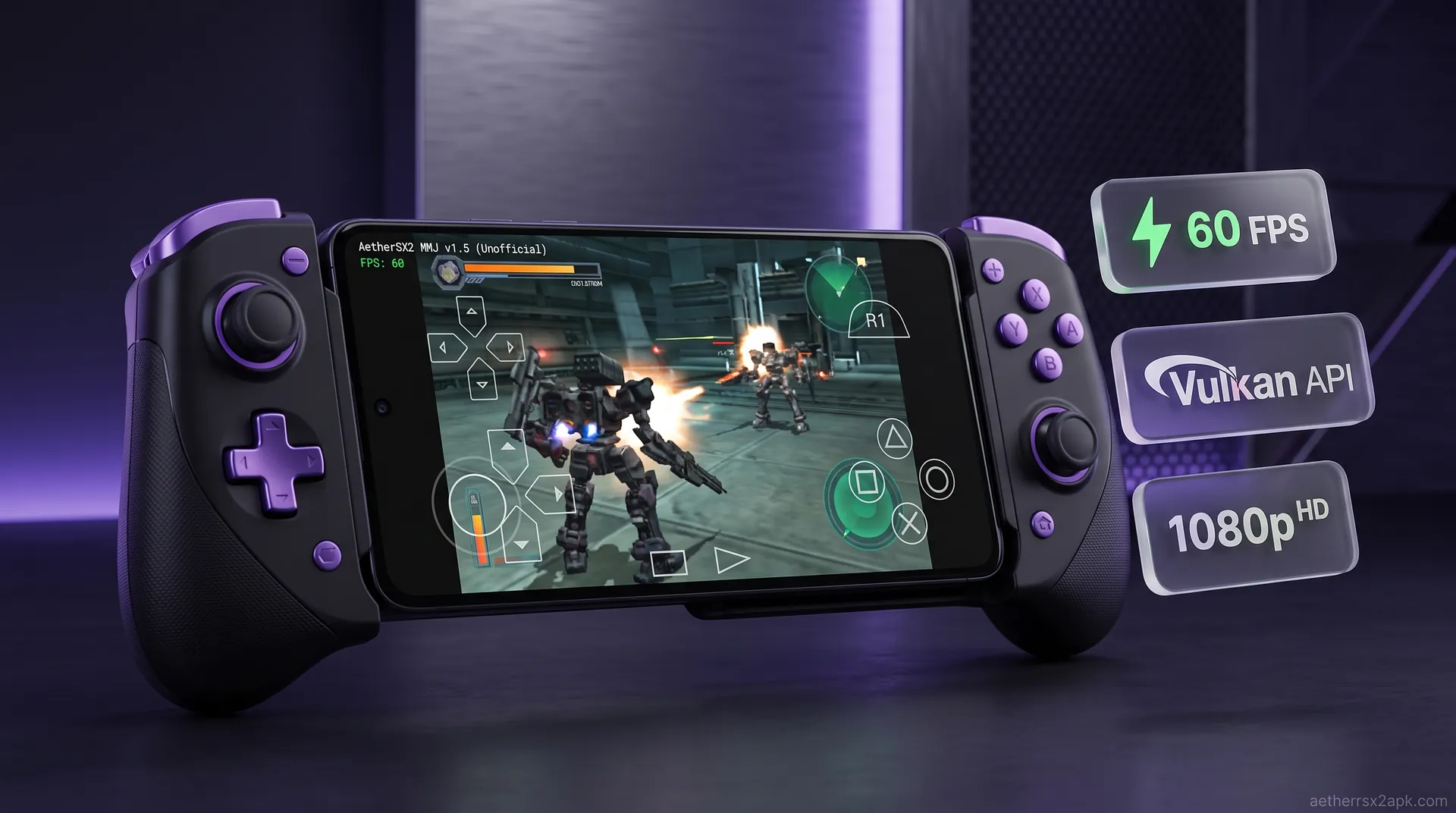
aethersx2 mmj
AetherSX2 MMJ and ARMSX2 Unofficial Forks
By HBKPublished Last updated
Quick summary
AetherSX2 MMJ and ARMSX2 are unofficial forks of a frozen Android PS2 emulator. They are not NetherSX2, not PCSX2, and not a safe default. Unsigned "faster APK" listings are a malware vector.
- Recommended: NetherSX2 patch of v1.5-4248
- MMJ / ARMSX2: unverified performance claims; missing or broken features
- Verify: known SHA-256 from a project you trust — not a random mirror
- Same BIOS: forks still need a dump from a PS2 you own
When the original development of AetherSX2 ceased, it left a massive void in the Android PlayStation 2 emulation community. Almost overnight, various community forks, spin-offs, and modded APKs began circulating on Reddit, Discord, and file-sharing websites. These unofficial builds aggressively promised better performance, permanently removed ads, magical speed hacks, and optimized compilers. Among the most widely circulated and hotly debated of these variants are AetherSX2 MMJ (frequently updated as MMJ2) and ARMSX2.
But what exactly are these forks? Who is developing them, and more importantly, are they safe to install on your daily driver Android device? Do they actually deliver on their lofty performance promises, or are they simply exploiting a desperate user base looking for the next big leap in mobile emulation?
The sections below separate MMJ/MMJ2 from ARMSX2, compare them with NetherSX2, and spell out the malware risk of unlabeled “mod APKs.”
On this page ▾
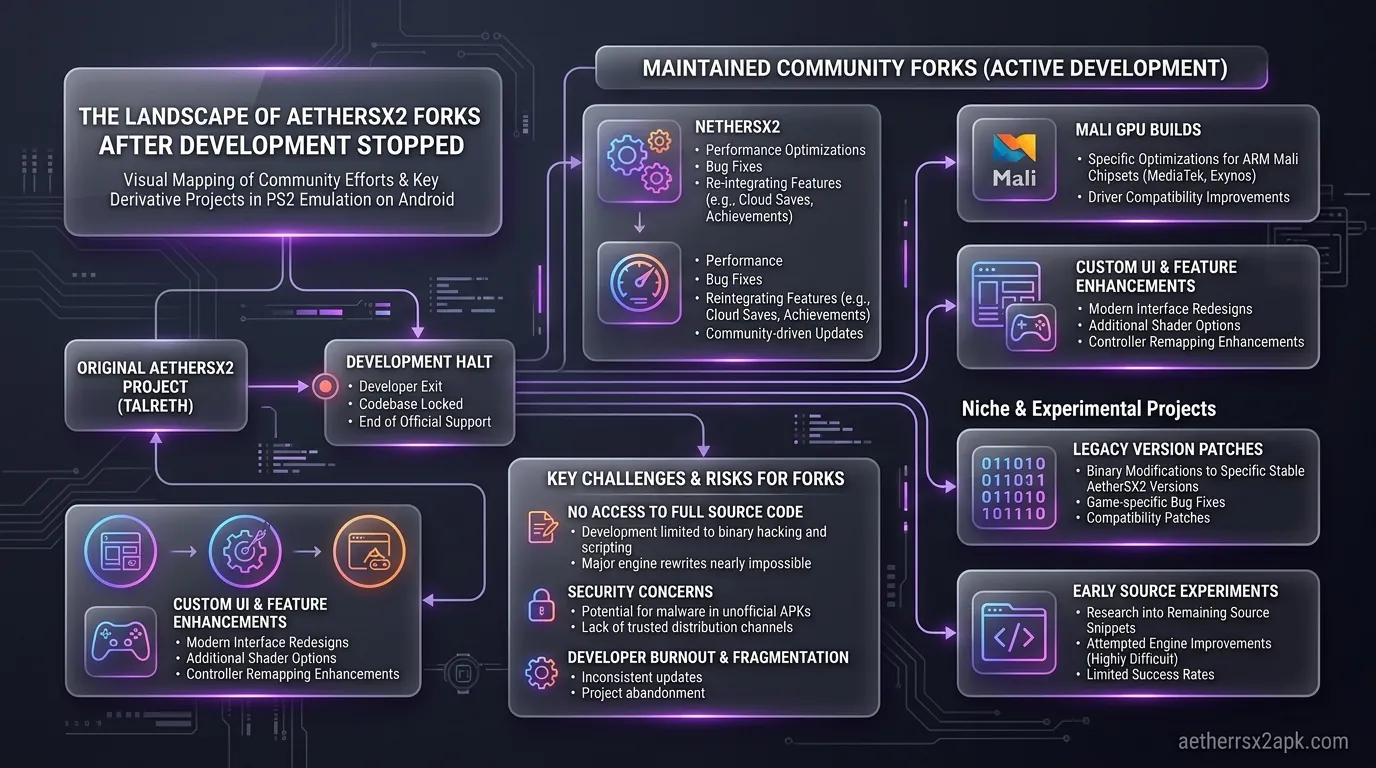
AetherSX2 was, without exaggeration, a monumental achievement for Android gaming. Built by the exceptionally talented developer known as Tahlreth, and heavily based on the legendary open-source PCSX2 project for PC, it finally made playing complex PlayStation 2 games on mobile devices a viable, smooth, and highly enjoyable experience. Before AetherSX2, Android gamers had to rely on either shady, ad-ridden apps that stole code without credit, or poorly optimized alpha emulators that could barely boot commercial games.
The final official build from the original developer, version 1.5-4248, was released in August 2023. Unfortunately, the path to this final release was fraught with community toxicity. Due to persistent harassment, death threats, and entirely unrealistic demands from some extremely vocal and entitled corners of the internet, the developer understandably suspended the project indefinitely. The official app was left on the Google Play Store with built-in advertisements in its final update, and the community was left without a clear path forward for future updates, compatibility fixes, or performance enhancements.
Why Did Forks Emerge?
Whenever a highly popular, beloved open-source (or in this case, partially open-source) project is abruptly abandoned, the community inevitably steps in to fill the gap. In the case of AetherSX2, the demand for an ad-free, high-performance PS2 emulator was simply too massive to ignore. The mobile gaming audience numbers in the hundreds of millions, and the nostalgia for the PS2 era is incredibly strong. Players desperately wanted the core AetherSX2 experience without the intrusive banner ads added in the final versions. They also wanted compatibility fixes for newer Android versions (like scoped storage fixes for Android 13 and 14) and performance tweaks that would allow heavier games to run on budget, lower-end hardware.
This immense demand led directly to a "Wild West" era of modded AetherSX2 APKs. While some developers sought to genuinely improve the emulator through transparent patching methods: which eventually led to the creation of the highly respected NetherSX2 project: others took a much more opaque, opportunistic route. This chaotic environment birthed numerous unverified "forks" that claimed to be the next big thing in mobile PS2 emulation. They popped up in YouTube video descriptions, sketchy Telegram channels, and anonymous forums, promising the world to anyone willing to hit download.
The Dangers of Unofficial APKs
The fundamental problem with this post-development landscape is that AetherSX2 was never fully open-source in the traditional sense. The core emulation backend, derived from PCSX2, is open-source (licensed under LGPL), but the Android-specific frontend UI and integration code developed by Tahlreth were proprietary. Modifying the app essentially requires decompiling the APK, editing the compiled code or smali directly, and recompiling it.
When anonymous individuals release these pre-compiled, modified APKs on random file-sharing sites without sharing the source code of their changes, it introduces massive security risks. As an end user, you have absolutely no idea what has been added or removed from the code. It is within this murky, untrustworthy ecosystem that names like "AetherSX2 MMJ" and "ARMSX2" began to gain massive traction.
What is AetherSX2 MMJ / MMJ2?
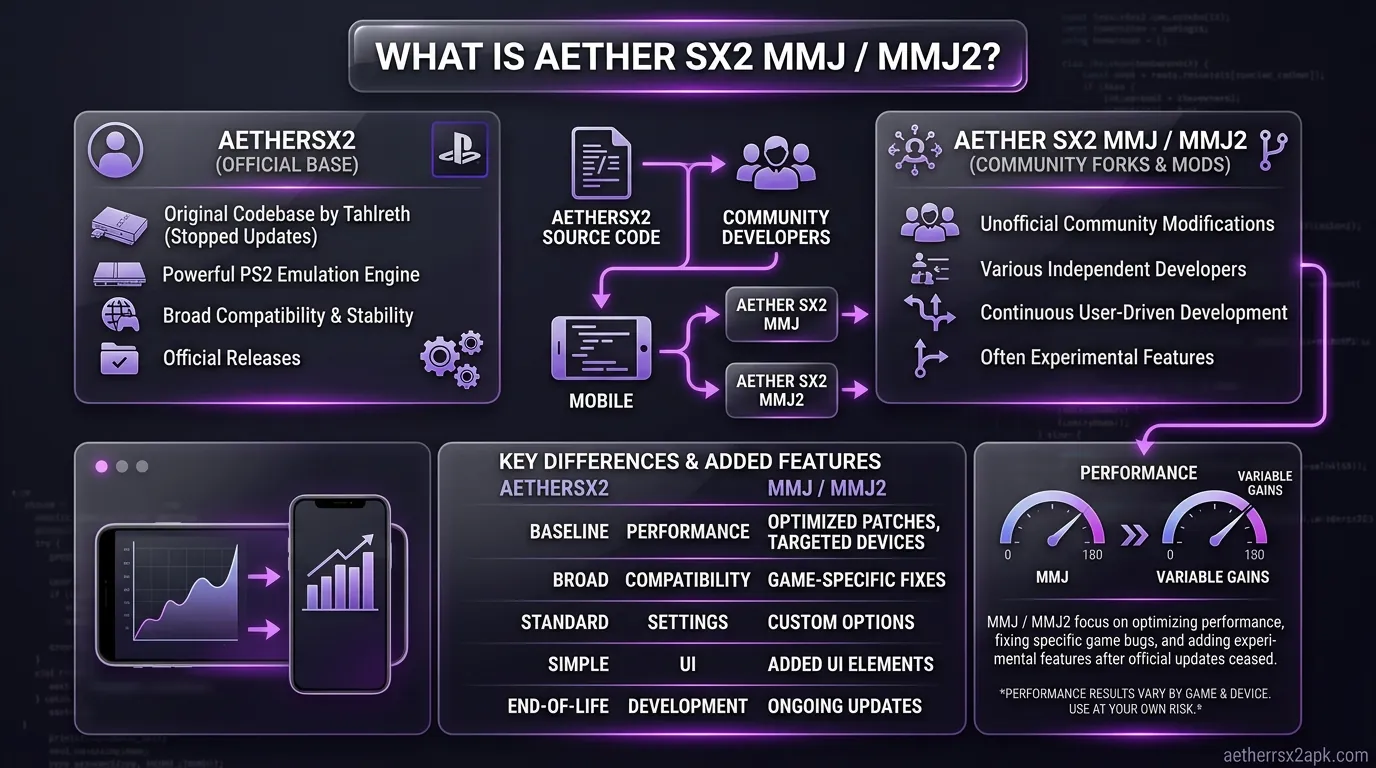
If you have been deeply involved in the Android emulation scene for a while, the "MMJ" tag might immediately ring a bell. The acronym was originally popularized by an exceptionally talented developer known as Weihuoya, who created highly acclaimed "MMJ" (frequently translated to Mobile Memory Joystick, though the exact meaning has morphed over time) forks of other major emulators like Citra (for the Nintendo 3DS) and Dolphin (for the Nintendo GameCube and Nintendo Wii).
Those original MMJ forks were famous for implementing aggressive speed hacks, custom graphics drivers, and clever workarounds that drastically improved performance on mid-range and low-end Android devices, often sacrificing a bit of graphical accuracy for raw speed.
The "MMJ" Naming Convention: A Clever Ruse
When "AetherSX2 MMJ" and subsequently the updated "AetherSX2 MMJ2" started appearing on Reddit and YouTube, many users naturally assumed that the legendary developer Weihuoya had returned from a hiatus to work his performance magic on PlayStation 2 emulation. This is a massive and dangerous misconception.
The AetherSX2 MMJ builds circulating online were not created by the original MMJ developer. Instead, opportunistic modders actively co-opted the "MMJ" name to instantly gain credibility and trick unsuspecting users into downloading their modified APKs. By slapping the MMJ label on their files, they ensured high search volume and immediate trust from users who remembered the massive performance boosts from Dolphin MMJ.
Claimed Performance Tweaks
The anonymous individuals distributing AetherSX2 MMJ claim that these versions include a wide array of specialized speed hacks, modified Vulkan and OpenGL rendering pipelines, and custom ad-stripping code designed to make games run significantly faster on notoriously weak Mali GPUs (commonly found in MediaTek and Exynos processors). They often promise smoother frame rates, less stuttering, and perfect audio in heavy, notoriously difficult-to-emulate games like God of War II, Shadow of the Colossus, Gran Turismo 4, and Metal Gear Solid 2.
The Reality of AetherSX2 MMJ Performance
Despite the aggressive marketing tactics on YouTube, rigorous community testing reveals a vastly different reality. In side-by-side benchmarking, AetherSX2 MMJ builds rarely, if ever, provide any tangible performance benefits over the official AetherSX2 v1.5-3668 (the last ad-free official build) or NetherSX2.
Any perceived speed increases that users report are almost universally the result of the modder simply pre-configuring the emulator's settings under the hood. For example, the modder might have hardcoded aggressive underclocking (EE Cycle Skipping) or forced unsafe speed hacks to be enabled by default, without giving the user the option to disable them. You can achieve the exact same: and often much better: performance on the official AetherSX2 application by heading into the settings menu and manually adjusting the cycle rate and skip settings yourself. You can learn more about finding these official versions on our older versions page.
Furthermore, because these MMJ builds are closed-source modifications made by unknown entities blindly editing compiled code, they frequently introduce severe instability. Games that run perfectly fine on the official builds may suffer from random crashes, graphical glitches, or audio desyncs on MMJ versions due to haphazard code alterations. Essentially, you are trading stability and safety for a placebo performance boost.
What is ARMSX2?
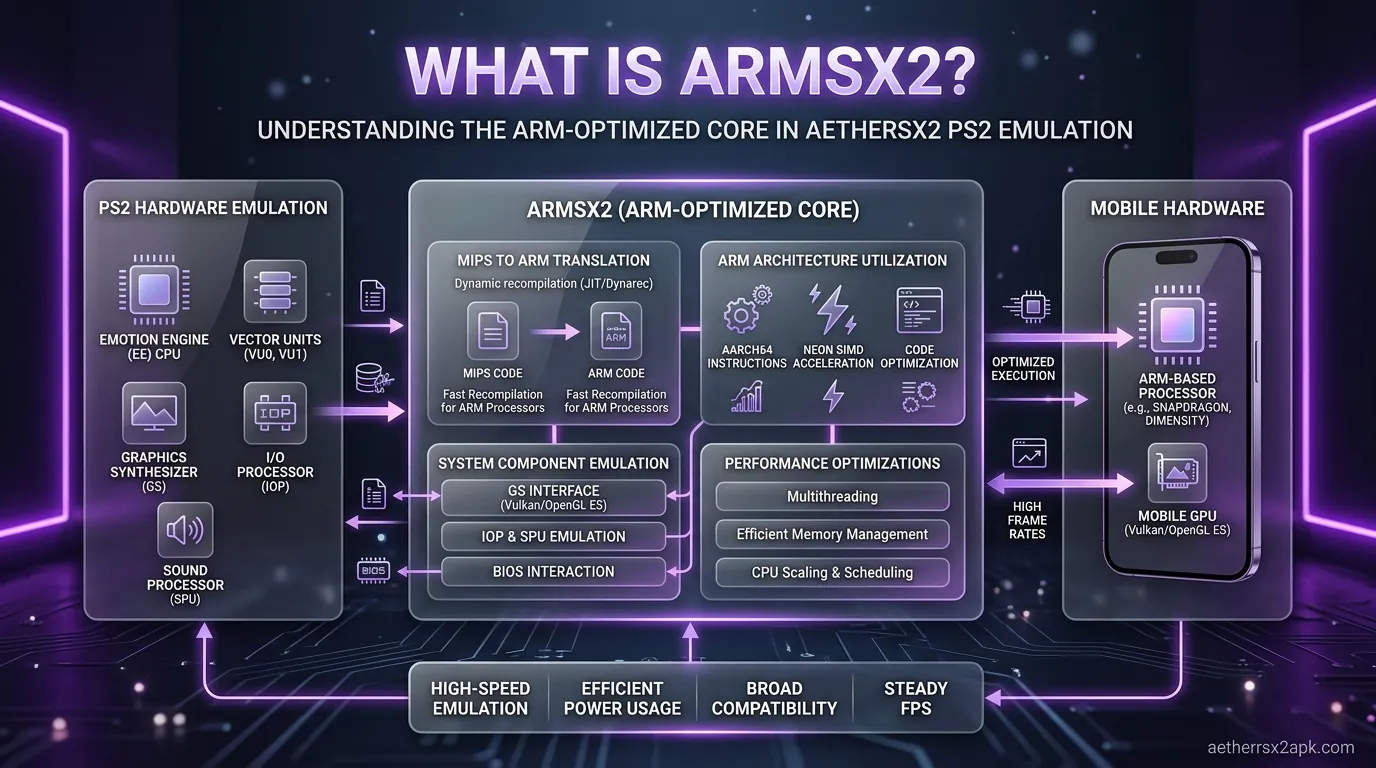
While the MMJ forks targeted the low-end device market with promises of magical speed hacks, ARMSX2 took a slightly different approach. ARMSX2 is another heavily discussed unofficial fork that appeared prominently on various emulation Discord servers and specialized Reddit threads. ARMSX2 pitched itself as a highly technical modification aimed at optimizing the emulator specifically for modern ARM architectures, particularly ARMv8 and the newer ARMv9 instruction sets found in flagship Snapdragon processors.
Experimental ARM Architecture Tweaks
The core technical claim behind ARMSX2 is that the modders supposedly rewrote, patched, or heavily adjusted certain parts of the AetherSX2 JIT (Just-In-Time) recompiler to better utilize the modern instruction sets of newer processors. In theory, for an emulation enthusiast, this sounds absolutely fantastic. A more optimized JIT compiler could significantly reduce CPU overhead, resulting in a much smoother emulation experience, particularly for games that heavily tax the PS2's complex Emotion Engine CPU architecture.
The creators claimed that by forcing the emulator to compile code differently, they could achieve 10-15% performance boosts on devices running Snapdragon 8 Gen 1, Gen 2, and Gen 3 chips.
Missing Features and Broken Functionality
The reality of ARMSX2, however, falls drastically short of its incredibly ambitious claims. Modifying a complex JIT compiler: especially one originally built for x86 architectures (PCSX2) and translated for ARM by Tahlreth: without access to the original uncompiled source code is a nearly impossible task. It requires deep, specialized, academic-level knowledge of both the proprietary PlayStation 2 hardware and the lower-level functions of the Android operating system.
Extensive testing of various ARMSX2 builds by prominent community members has shown that while some extremely specific, CPU-bound scenarios might see a marginal 1-2 FPS improvement, the emulator as a whole is highly unstable and fundamentally broken. Essential, core features of the emulator are often completely non-functional. For instance, save states (a crucial feature for mobile gaming) frequently corrupt upon loading. Controller mapping for certain Bluetooth gamepads stops working entirely, and the Vulkan renderer: which is absolutely vital for achieving good performance on modern Snapdragon devices: is prone to sudden graphical artifacting, memory leaks, or hard crashes straight to the Android home screen.
Is ARMSX2 Worth Trying?
For the vast majority of users, the answer is a resounding, unequivocal no. The minimal, highly situational performance gains are absolutely not worth the constant crashing, broken features, and overall lack of reliability. It serves more as an interesting, albeit ultimately failed, experiment in brute-force JIT modification rather than a daily driver for playing your favorite PlayStation 2 classics. Unless you are a developer looking to analyze broken code, ARMSX2 should be entirely avoided.
AetherSX2 Official vs NetherSX2 vs MMJ vs ARMSX2
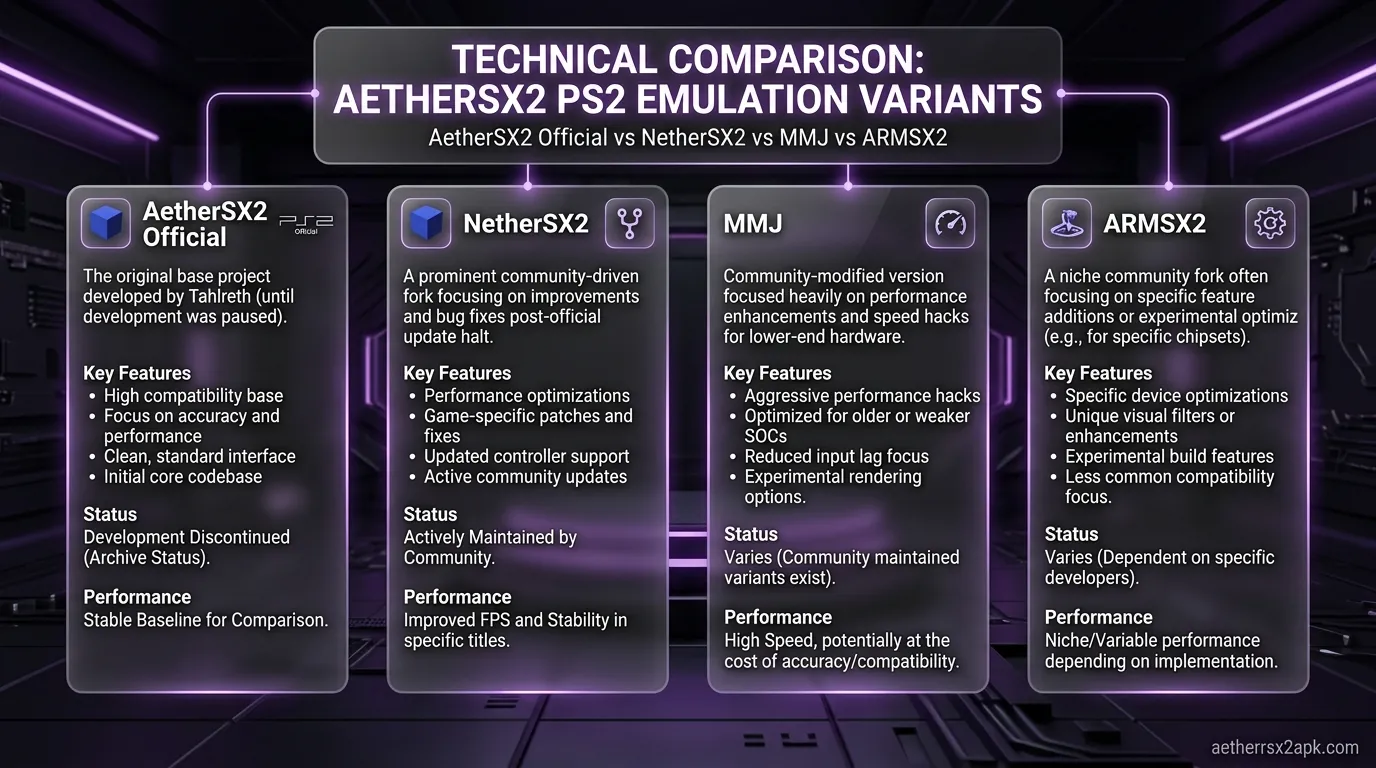
To help you understand exactly where these different versions stand in the current emulation ecosystem, we have compiled a comprehensive comparison table. This table evaluates the Official AetherSX2 (the final 4248 build), NetherSX2, AetherSX2 MMJ, and ARMSX2 across several critical categories.
| Feature / Category | AetherSX2 (Official v1.5-4248) | NetherSX2 (Community Patch) | AetherSX2 MMJ / MMJ2 | ARMSX2 |
|---|---|---|---|---|
| Developer | Tahlreth (Original Dev) | Community / EZOnTheEyes | Unknown / Anonymous | Unknown / Anonymous |
| Ad-Free | ❌ No (Intrusive Ads present) | ✅ Yes (Ads completely removed via script) | ⚠️ Claimed (Often true, but very risky) | ⚠️ Claimed |
| Performance | Excellent (The Baseline Standard) | Excellent (Matches official exactly) | Highly Variable (Often faked or pre-configured) | Unstable (Prone to hard crashes) |
| Code Transparency | Closed Source Frontend | Open Patch Scripts (100% transparent) | Closed/Hidden (Obfuscated) | Closed/Hidden (Obfuscated) |
| Android 14+ Fixes | ❌ No (Suffers from scoped storage issues) | ✅ Yes (Community fixed file access) | ❌ No | ❌ No |
| Safety / Security | ✅ Safe (If downloaded from Play Store/Archive) | ✅ Safe (You patch the official APK yourself) | ❌ High Risk (Potential malware) | ❌ High Risk (Potential malware) |
| Update Status | Dead (August 2023) | Active Community Updates & Game DB fixes | Dead / Abandoned | Dead / Abandoned |
Why NetherSX2 Leads the Pack
As you can easily discern from the table above, NetherSX2 is the clear, uncontested winner for anyone looking to play PlayStation 2 games on an Android device today. If you want a deep dive into the specific, granular differences between the official release and the Nether project, we highly recommend checking out our full AetherSX2 vs NetherSX2 comparison guide.
NetherSX2 succeeds everywhere that MMJ and ARMSX2 fail primarily because of its methodology and philosophy. Instead of distributing a shady, pre-compiled APK, the NetherSX2 project provides a transparent patching script. You download the official AetherSX2 APK from a trusted archive, run the Nether script over it using a PC or a builder app on your phone, and the script actively removes the ads, patches in newer Android support, and applies community fixes. This ensures that you know exactly what is happening to the app, keeping your device safe while providing the absolute best possible emulation experience. It is the gold standard for PS2 on Android.
Safety & Security Risks of Downloading Unlabeled Modded APKs
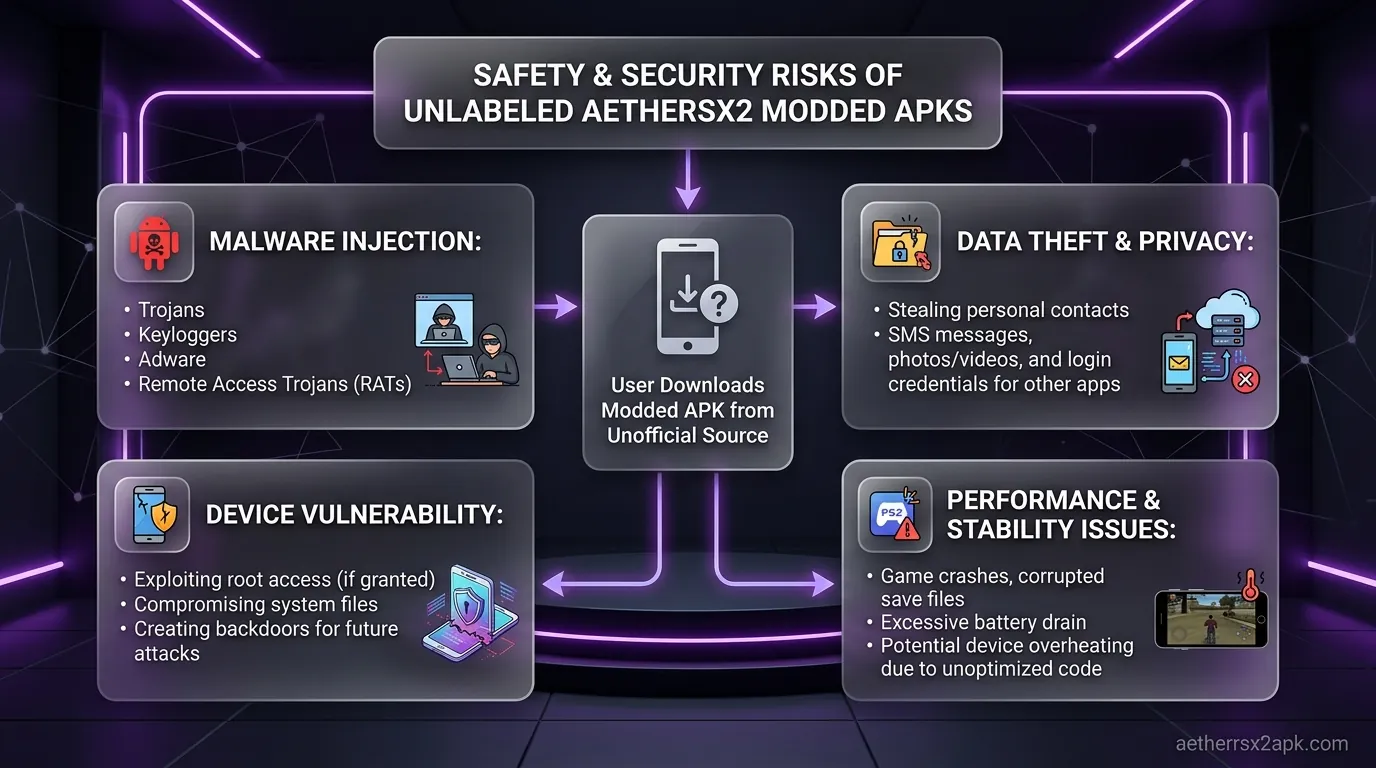
The emulation community relies incredibly heavily on trust. Because emulators are incredibly powerful applications that require deep access to your device's storage, file systems, and hardware components (like the GPU and CPU), installing a compromised emulator can have disastrous, far-reaching consequences. This is the primary reason we strongly, vehemently advise against downloading AetherSX2 MMJ, MMJ2, ARMSX2, or any other randomly named modded AetherSX2 APK from YouTube video descriptions, obscure file-sharing sites, or untrusted Discord servers.
Malware and Spyware Threats
When you download a pre-compiled modded APK from an anonymous source, you are essentially rolling the dice with your device's security and your personal privacy. It is incredibly easy for a malicious actor to take the legitimate AetherSX2 APK, decompile it, inject a payload of dangerous malware or spyware, recompile it, slap the name "AetherSX2 MMJ" on it, and upload it to the internet.
Once installed, this malware can run silently in the background. It can log your keystrokes (potentially stealing banking passwords or social media logins), steal your personal photos and data, intercept two-factor authentication SMS messages, and completely compromise your digital life.
Ad-Injection and Data Harvesting
Even if a modded APK doesn't contain outright, destructive malware, it may very well be injected with aggressive adware or sophisticated data-harvesting trackers. Ironically, millions of users download these "MMJ" versions specifically to escape the banner ads present in the final official AetherSX2 build, only to end up installing a version that secretly mines their data, tracks their location, or displays hidden, invisible ads in the background to generate illicit revenue for the modder. This hidden background activity will also severely drain your battery and use up your mobile data allowance.
How to Verify Your APK
If you are ever unsure about the legitimacy of an APK file, you should always err on the side of caution. Before installing anything outside of the Google Play Store, you should run the APK file through a reputable malware scanner like VirusTotal. However, it is important to note that scanners are not perfect and can miss zero-day obfuscated malware.
The absolute best defense is simply avoiding unverified forks altogether. Do not let the promise of a few extra frames per second tempt you into compromising your phone. Stick to the officially archived, unmodified versions found on our older versions page or take the few extra minutes to build your own safe NetherSX2 APK using the public, transparent scripts.
Why NetherSX2 is the Recommended Community Standard over Unverified MMJ Builds
The PlayStation 2 emulation scene on Android is currently centered firmly and definitively around NetherSX2, and for excellent reasons. It manages to provide everything that the MMJ and ARMSX2 forks promised: no advertisements, better performance on newer devices, Android 14 scoped storage fixes, and continued community support: without any of the security risks, malware threats, or inherent instability.
Transparency and Open Source Patches
The most crucial difference between NetherSX2 and the risky forks is transparency. As previously mentioned, the NetherSX2 project fundamentally refuses to distribute pre-modified APKs. Instead, they provide a set of open-source scripts. You can literally open these scripts in any text editor and read exactly, line-by-line, what code is being changed.
The script safely removes the Google AdMob dependencies, fixes scoped storage issues that prevent Android 13 and 14 users from selecting their game folders, and updates the internal game compatibility database to fix graphical glitches in specific titles. Because the patching happens transparently and locally on your own machine, you can be 100% certain that no malware or spyware is being injected. It is a community-driven, safety-first approach to preserving the emulator. For the base install before you apply MMJ/ARMSX2 forks, start at the APK install walkthrough.
The Legality and Ethics of Emulation
It is also absolutely vital to remember the legal foundations of emulation. Emulators themselves, like AetherSX2 and NetherSX2, are perfectly legal pieces of software. They are essentially just blank virtual machines that translate instructions. However, they require a PlayStation 2 BIOS file to function. You must always dump this BIOS from your own legally owned, physical PS2 console. Downloading a BIOS from the internet is illegal and constitutes copyright infringement.
Similarly, you must dump your own games from physical discs that you legally own into ISO, CHD, or CSO formats. When you rely on sketchy, anonymous forks like MMJ, you are often engaging with shady communities that actively encourage piracy and the illegal distribution of copyrighted files. Sticking to the standard NetherSX2 project keeps you aligned with the ethical, legal emulation community, which respects copyright law while striving to preserve gaming history.
Unofficial forks are not NetherSX2. The patch this site documents is NetherSX2-patch. Upstream lineage: PCSX2 and PCSX2 GitHub.
Frequently Asked Questions
1. Did the original AetherSX2 developer create AetherSX2 MMJ? No, absolutely not. The original developer, Tahlreth, has absolutely no connection, affiliation, or involvement with AetherSX2 MMJ, MMJ2, or ARMSX2. These forks were created by anonymous third parties who purposely used the popular "MMJ" naming convention (borrowed from Citra and Dolphin forks) to trick users into downloading their potentially dangerous files.
2. Does AetherSX2 MMJ actually give better FPS on low-end phones? Generally speaking, no. Any perceived performance boost in MMJ builds is usually because the modder has forcefully enabled severe underclocking settings (EE Cycle Skipping) by default. You can achieve the exact same (and often much better, more stable) performance by simply tweaking the settings yourself on the official AetherSX2 or NetherSX2 apps. There is no "magic code" in MMJ making it faster.
3. Is ARMSX2 safe to install on my Android device? We emphatically do not recommend installing ARMSX2. Because it is a closed-source modification distributed by unknown, untrusted sources, there is a very high risk that the APK could contain malware, spyware, or aggressive data-harvesting trackers. Furthermore, the app itself is highly unstable, prone to crashing, and has fundamentally broken features like save states.
4. Why did AetherSX2 development stop in the first place? The original developer, Tahlreth, suspended development indefinitely in August 2023. He cited severe burnout, constant harassment from users demanding features or fixes for extremely obscure phones, and even death threats as the primary reasons for stepping away from the project. The community's toxicity ultimately drove him away.
5. How do I get an ad-free version of AetherSX2 safely without using MMJ? The absolute safest way to get an ad-free PS2 emulator is to use NetherSX2. You can use the open-source Nether patching scripts to remove the ads from the official AetherSX2 v1.5-4248 APK yourself. Alternatively, you can simply download and use an older, official build of AetherSX2 (specifically v1.5-3668) from before the developer introduced advertisements.
6. Do I still need a PS2 BIOS for MMJ, ARMSX2, and NetherSX2? Yes. Regardless of which fork or version of the app you decide to use, the core emulation code remains identical. You will always, without exception, need a legitimate PlayStation 2 BIOS file dumped directly from your own physical PS2 console in order to boot the emulator and play games.
Disclaimer: This guide is for educational and informational purposes only. aetherrsx2apk.com does not host, distribute, or link to any copyrighted materials, including PS2 BIOS files or game ROMs. Users are solely responsible for ensuring they possess the legal right to emulate the software they own according to their local laws.